Post
The 'young blood' of the Chinese gaming industry, evolved into a typhoon
Back in the winter of 2019, before COVID-19, I went on vacation to Beijing, China. There, I met the CEO of an indie game development company who I had become friends with at GDC and ChinaJoy. He was a fan of Japanese manga and anime, and that influence was evident in his games. His favorite works included Akira, Ghost in the Shell, and Evangelion. So, we naturally became friends from the first time we met, and we often shared stories while using Japanese and English.
Chinese developers are usually reluctant to talk about sensitive topics in public or private, whether in the media or in official settings. There's an unspoken atmosphere where even mentioning the reason is avoided. However, after visiting his studio and having a few drinks at dinner, I was able to hear him speak candidly.
"In China, you can't make your own games at a company once you turn 40. So, my friends, the people who came to our company, we had no choice but to come out and make games like this."
The Success of Young Leaders Becomes a Catalyst
I remembered him mentioning in an interview that he wanted to make a fun console package game before he turned 40. Not only that, but most of the studio's nearly 30 employees, including the two co-founders, were in their early 80s, people who would soon be turning 40.
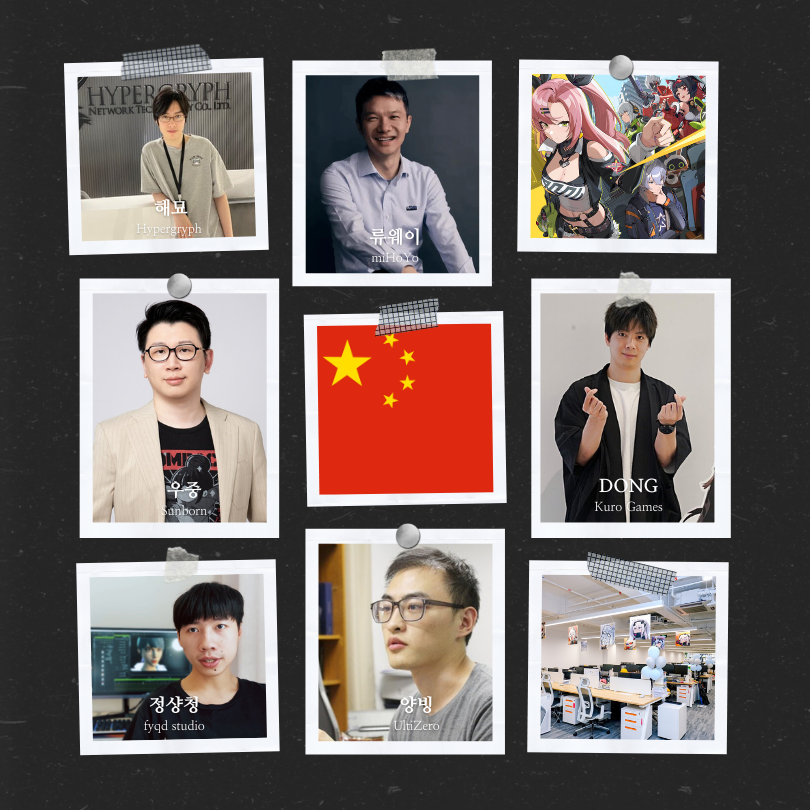
Over the next four years, China's doors were tightly closed for a while. Then, they gradually began to open, and as I visited China again or met Chinese developers abroad, his words came back to me. It's already well known in Korea that young Chinese developers such as miHoYo's Liu Wei, Sunborn Network Technology's UMP45, and Hypergryph's Hai Mao are rapidly rising. However, among the core personnel of Chinese game companies' projects that I met at local Chinese events and overseas game shows, there were many who were of a similar age to him or even younger.
It wasn't always the case that the Chinese game industry was like that from the beginning. Or, to be precise, the perception of Chinese games changed so drastically only after the aforementioned three developers began to showcase their work and some time had passed. 'Honkai Impact 3rd' and 'Girls' Frontline' were released in 2016 and gained explosive popularity in Korea a year later, so it all happened in about seven years.
Before that, the term 'Chinese game' itself had a negative connotation. No matter what game came out, if the words 'Chinese game' were attached, no amount of praise could help. There was so much prejudice, and there were so many games that could only be viewed from that perspective, so the vicious cycle of reinforcing that prejudice continued. And while there are still many such games, most of the game types that have broken free from prejudice have something in common: a strong obsession with 'subculture,' or 'console games' or 'Triple A games'.
Challenging Subculture, Console, and Triple-A Package Games That the Older Generation Hasn't Touched
As is well known, the Chinese market is very closed off. In addition to the 'Panhao' that is often mentioned in the game industry, there are fences in many areas, including the Golden Shield Project, an internet censorship system that blocks the entry of Google and Facebook. However, there was a huge domestic market, and based on this, the game industry has built its own ecosystem focused on MMORPGs, web games, and SLGs tailored to the domestic market.
Or, to be precise, there wasn't much of a choice. In 2000, the Chinese government issued a ban on console game consoles, and after that, there was no opportunity to see console game consoles 'officially' in China. The measure continued until 2014, and naturally, many Chinese developers couldn't even think of developing console games.
However, Japanese manga and anime came in relatively freely, and the number of young people enjoying them increased. However, with a lack of a central community, the Shanghai Comic Cup, a large-scale secondary creation event similar to Comiket, was held in 2009, and the video site 'bilibili', which emphasized subculture, appeared in 2010, causing a change. Creators who wanted to go beyond just liking subculture and create their own works gathered and had a space to interact. Along with that trend, young Chinese developers such as UMP45, Hai Mao, and Liu Wei showed a movement to create and showcase the games they liked.
Of course, their challenges weren't successful from the start. 'FlyMe2theMoon', which Liu Wei released in 2011 while he was a graduate student at Shanghai Jiao Tong University with Cai Haoyu and Luo Yuhao, was a game where all you had to do was control Kiana to safely reach the goal while avoiding obstacles. And at a meeting to find investors for game development, he emphasized the possibility of subculture games, but investors even scoffed, saying, "Put away those weird 2D bishoujo games." UMP45, who created the doujin team 'Mica Team' before founding Sunborn Network, released 'Bakery Girl' in 2013, but it was only talked about among some subculture users, and the planned sequel production failed due to differences of opinion and limitations of circumstances.
Nevertheless, they didn't stop. miHoYo released the run-and-gun RPG 'Honkai Gakuen 2' in the Chinese market in 2014 and poured most of the profits into R&D, showing a quantum jump with 'Honkai Impact 3rd' in 2016. 'Honkai Impact 3rd', which featured famous Japanese voice actors, as well as elaborate cartoon rendering graphics and flashy action that didn't differ much from the illustrations, attracted attention even in Japan, the home of subculture, and recorded top sales in Korea when it was released in Korea in 2017.
Going one step further, they aggressively hired development personnel again from 2018 and continued R&D, and in 2020, they introduced the full-fledged subculture open-world RPG 'Genshin Impact'. In 2018 alone, there were about 500 employees, but when I visited miHoYo in 2019, a year later, there was aggressive investment and expansion of personnel to the point where there were more than 1,000 employees. They were expanding their office in one building in the Shanghai Putian Industrial Park to three buildings, and they were constantly making room for new employees. Among Chinese developers, there was even talk that "it would be a disaster if 'Genshin Impact' didn't do well." The results are obvious. And now, with the global brand 'HoYoverse', it has emerged as a company that is attracting worldwide attention whenever it releases new works such as 'Honkai: Star Rail' and 'Zenless Zone Zero'.
After the failure to develop the sequel to Bakery Girl, UMP45 established a corporation called 'Sunborn Network Technology' in 2015 and gathered Hai Mao and several other developers who had become friends while doing doujin activities. 'Girls' Frontline', which was developed with the slogan that they wanted to play a bishoujo game where they tactically deployed modern weapons, but no one was making it satisfactorily, was released in 2016 and became known little by little in China, Japan, and Korea. 'Girls' Frontline', which showed not only elegant illustrations and high-quality SD characters, but also details such as various combinations, micro-control, and unit management to the advantages of the so-called 'Kore-ryu', gained an explosive response after its release in Korea in 2017. And even now, it is one of the pillars that has raised the genre of 'subculture' in the Korean game market.
Hai Mao, who developed with UMP45 and then joined Hypergryph to make his own game, imprinted 'Arknights' on subculture fans from before its release in 2017, showcasing a PV that broke the established style of subculture. Although it sometimes appears in some unofficial mad movies, it was rare to officially match alternative rock with a PV that matched the feeling. 'Arknights', which maximized the appeal of the setting and character design while minimizing exposure in that unique style, also showed a unique strategy compared to other tower defenses that had been released, and is still a work that has solidified its user base to the point where it is called 'concrete'. That series of trends stimulated developers in other cities such as Guangzhou and Beijing as well as Shanghai, and young developers began to emerge as directors or PDs in order to capture the subculture trend.
Meanwhile, young developers have also stepped up in console games and Triple A, and the path is gradually opening up. One example is 'Lost Soul Aside'. Yang Bing, who started developing 'Lost Soul Aside' alone in 2016 while studying in Korea, inspired by Final Fantasy XV, surpassed 1 million views on YouTube in just one week. After completing his master's degree and returning to Korea, he gathered like-minded developers to establish 'Ultizero' and received a collaboration proposal from SIE.
At the time, SIE had been seeking ways to expand its market by entering the Chinese market in 2014. However, since it was difficult to even officially play console games in China for 14 years from 2000, it was difficult to find console game creators in China. As mobile games rose after online games, many Chinese game developers with that capability did not pay much attention to console games. So, to make a console game, you had to break down the company door and headbutt, and naturally, games of a scale that would attract attention were not easily visible.
In that situation, however, the situation gradually changed as young Chinese developers who were serious about console games, such as Yang Bing, stepped up. Starting with 'Lost Soul Aside', various Chinese console games gradually caught the eye of SIE, and in 2017, SIE launched the 'China Hero Project' to support Chinese console game companies. The China Hero Project booth, which was initially set up on a small scale in the corner of the ChinaJoy PS booth, gradually became a course that captured the attention of Chinese gamers at ChinaJoy, which was mainly held with on-site events, and naturally had the effect of raising interest in console games.
In addition, the fact that key developers from companies that made a name for themselves with subculture games were interested in console games also created synergy, and the PS booth gradually expanded in size and lineup. It was gradually informing users that there were other areas in China besides mobile games and online games. In the midst of that atmosphere, Game Science, a new developer that had only stopped the multiplayer strategy game 'Art of War' in the early access stage in 2016, made a fresh start and put a period on it by showcasing the trailer for 'Black Myth: Wukong' in 2020. Four years later, they are trying to show the results.
The First Generation Continues to Challenge, and More Boldness and 'Youth' Must Be Added
Sometimes it is said that Chinese games have surpassed Korean games. There may be differences of opinion on that opinion, but at least it cannot be denied that Chinese games have developed rapidly through a turbulent period, as seen above.
And at the center of that were young developers who moved forward in line with the new era. They opened up the path, and other young developers and new companies, as well as existing developers, were stimulated by this and began to step into areas they had not challenged before. And they are gradually achieving results. They are attracting attention in the home of subculture and at overseas game shows, and are going global.
The growth of the Chinese game market, which has developed so rapidly, is actually unusual. In addition, it is also compared to the blocked movements of some game companies that are somewhat stagnant now. miHoYo was founded in 2011 by three graduate students, and is now a huge developer with more than 5,000 employees worldwide. According to a report by 'Ke Chuang Ban Daily', a Chinese IT securities market media outlet, miHoYo's revenue in 2023 is estimated to be 40 billion yuan (approximately 7.3 trillion won), and operating profit is estimated to be 28 billion yuan (approximately 5.11 trillion won). Another media outlet, Guangming Daily, estimated its performance in 2022 to be 27.3 billion yuan in revenue (approximately 5 trillion won) and 16.1 billion yuan in operating profit (approximately 2.94 trillion won). On the other hand, NCsoft, which was considered a leading player in the first generation of Korean developers at the time of miHoYo's founding, with the Lineage series, Aion, and the new 'Blade & Soul' on the horizon, is now talking about restructuring, voluntary retirement, and overcoming the crisis.
Of course, not all first-generation developers, or developers, show such a trend. Shift Up, led by Kim Hyung-tae, one of the first-generation developers in Korea, is receiving favorable reviews from both users and critics for 'Stellar Blade', which challenged console games following the success of Goddess of Victory: Nikke, raising expectations for its next work. Similarly, Nexon Games, led by CEO Park Yong-hyun, has succeeded in 'Blue Archive' thanks to the efforts of first-generation otaku developers such as PD Kim Yong-ha. And they are diversifying genres with the root shooter 'The First Descendant', which will be released this summer.
In addition, young developers are gradually gaining power in Korea as well. 'Dave the Diver' was originally a project called 'Dave' that was developed with National Geographic at Studio 42 in 2017, but thanks to the efforts of Director Hwang Jae-ho and the development team, it received overwhelmingly positive reviews from early access in 2022. In the official release in 2023, it recorded a Metacritic score of 90 and achieved the feat of winning the BAFTA Game Design Award for the first time in Korea. The power of Nexon's sub-brand 'Mintrocket', which gives strength to trying a completely different style from its existing games, was also a major factor.
Not only large developers, but also small and medium-sized indie developers are using materials that young developers have not tried before, or are showing bold investments to expand IPs. CEO Yoo Seung-hyun, who completed 'SANABI' by implementing the somewhat reckless idea of a Joseon cyberpunk rope action platformer, and CEO Kim Ji-hoon, who developed the world of 'Lobotomy Corporation' into a sequel and even established a permanent theme cafe 'HamHamPangPang', are examples of this. In particular, HamHamPangPang boldly entered the market at a time when the concept of a game IP collaboration cafe was only known to users who were so-called 'true fans' of the IP in Korea, inspiring industry figures including CEO Ryu Geum-tae.
Looking back, it has already been several years since the leading young developers in China were active. Compared to the achievements they have accumulated, the activities of young Korean developers may not be enough. But isn't it said that starting is half the battle? And since development in Korea has been mainly focused on MMORPGs, there is a need for a new perspective in a situation where we need to find other avenues besides MMORPGs.
Looking back, the first generation of Korean developers also boldly challenged the era of package games in their youth, with the passion to create games that could be enjoyed together by many people in line with the advent of high-speed internet, creating the heyday of MMORPGs and online games. Reading the changes of the times and responding to them proactively is something that industry people should do, and to create new trends, it is necessary to challenge more actively and boldly. That may not be the sole domain of young developers, but sometimes we can't just stand by and watch their passion and boldness bring about new results that we never thought of before.
Webzine InvenReporter Yoon Seo-ho
2024-05-24