Post
Satisfactory: Manifolds, Load Balancers, & Sushi Belts - Best & Worst Belt TypesThis video provides a detailed overview of three common machine loading methods in Satisfactory: Manifolds, Load Balancers, and Sushi Belts. It discusses the benefits, drawbacks, and practical applications of each method, offering insights into optimizing factory layouts and resource management.
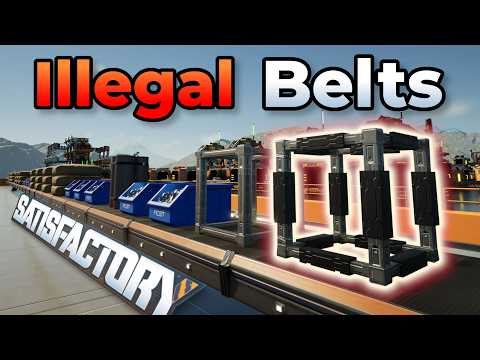
1. 🏭 Understanding Manifolds: Components, Construction, and Considerations
- ✅ A manifold consists of a throughput belt, a splitter, and a feed belt.
- ✅ Manifolds can be extended as needed, limited by the throughput belt's capacity.
- ✅ Vertical manifolds are easier to construct with vertical splitters and mergers.
- ⚠️ Upgrading vertical lifts requires upgrading each segment individually.
00:39 - 02:44
1. 🏭 Understanding Manifolds: Components, Construction, and Considerations
- ✅ A manifold consists of a throughput belt, a splitter, and a feed belt.
- ✅ Manifolds can be extended as needed, limited by the throughput belt's capacity.
- ✅ Vertical manifolds are easier to construct with vertical splitters and mergers.
- ⚠️ Upgrading vertical lifts requires upgrading each segment individually.
02:45 - 04:47
2. ⚖️ Manifold Advantages, Disadvantages, and Effective Workarounds
- ✅ Manifolds are space-efficient and easy to set up with minimal materials.
- ⚠️ Longer manifolds can lead to earlier machines being oversupplied while later ones are starved.
- ✅ Workarounds include hand-loading machines or temporarily underclocking them to balance resource distribution.
04:48 - 08:20
3. 🔄 Load Balancers: Achieving Even Resource Distribution
- ✅ Load balancers ensure even loading of machines right from the start, beneficial for complex parts.
- ✅ Useful for balancing freight stations to prevent train imbalances.
- ✅ A 2:2 balancer uses splitters and mergers to balance output flow, regardless of input differences.
- ✅ Conversion balancers convert a number of inputs into a different number of balanced outputs using recirculation.
08:21 - 09:13
4. 📚 External Resources for Advanced Load Balancing
- ✅ The video references NicoBuilds' Reddit write-up and YouTube channel for constructing load balancers for complex ratios.
09:14 - 11:11
5. 🍣 Sushi Belts: Combining Multiple Items on a Single Belt
- ✅ Sushi belts move more than one type of item, using smart splitters to guide items to the correct machines.
- ✅ Smart splitters are configured to allow specific items to pass through to machine inputs, with overflow set to redirect excess.
- ✅ Outputs of multiple machines can be merged onto a single sushi belt for efficient transport of low-throughput items.
- ✅ Sushi belts can temporarily move items for other production lines.
- ✅ Sushi belts are space-efficient compared to dedicated belts for each item.
11:12 - 13:31
6. ⚠️ Drawbacks of Sushi Belts and Mitigation Strategies
- ⚠️ Sushi belts require an overflow solution, such as a sink, to prevent backups caused by incorrect item order.
- ⚠️ Sushi belts inherit manifold problems, such as quickly consuming belt capacity.
- ✅ Solutions include using sushi belts for smaller inputs or upgrading the throughput belt.
- ⚠️ Speed discrepancies between throughput and feed belts can prevent proper machine loading.
- ✅ Upgrading feed belts can resolve loading issues.
- ✅ Mixing sushi belts with dedicated belts for high-throughput items can optimize space and capacity.
13:32 - 15:51
7. 🏗️ Factory Tour and Patreon Shout-Outs
- ✅ The video mentions a free factory mega print available on Patreon.
- ✅ The Fix It Learning Institute was created as a fully functioning factory to showcase the belting concepts.
- ✅ Patreon supporters receive access to mega print libraries and project updates.