Post
2026 Compact Smartphone Showdown: Galaxy S26, iPhone 17, Xiaomi 17, Pixel 10 In-depth ComparisonWhat is the best compact smartphone launched in 2026? We've meticulously analyzed the design, camera performance, battery life, and overall user experience of four models: Galaxy S26, iPhone 17, Xiaomi 17, and Pixel 10. We'll help you identify the pros and cons of each device to find the smartphone that's right for you.
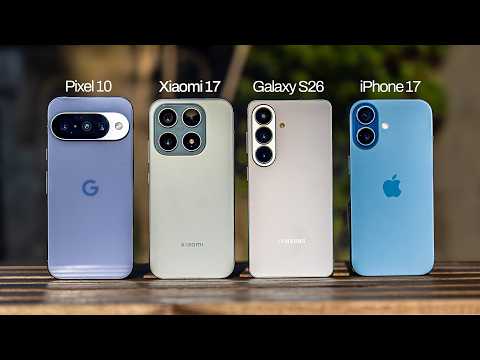
1. 📱 2026 Compact Smartphone Design and Features
· We compare the Galaxy S26, Xiaomi 17, Pixel 10, and iPhone 17 to find the best compact smartphone of 2026.
· The Pixel 10 features a classic design with a glass back and a triple camera.
· The Galaxy S26 introduces a new camera module design, similar to the S26 Ultra, and is released in two versions: Exynos and Snapdragon.
· The Xiaomi 17 boasts a Leica-branded triple camera system and a large battery (6330mAh global, 7000mAh China).
· The iPhone 17 maintains a classic design with added camera and action buttons.
· The Pixel 10 features a classic design with a glass back and a triple camera.
· The Galaxy S26 introduces a new camera module design, similar to the S26 Ultra, and is released in two versions: Exynos and Snapdragon.
· The Xiaomi 17 boasts a Leica-branded triple camera system and a large battery (6330mAh global, 7000mAh China).
· The iPhone 17 maintains a classic design with added camera and action buttons.
00:00 - 01:15
1. 📱 2026 Compact Smartphone Design and Features
· We compare the Galaxy S26, Xiaomi 17, Pixel 10, and iPhone 17 to find the best compact smartphone of 2026.
· The Pixel 10 features a classic design with a glass back and a triple camera.
· The Galaxy S26 introduces a new camera module design, similar to the S26 Ultra, and is released in two versions: Exynos and Snapdragon.
· The Xiaomi 17 boasts a Leica-branded triple camera system and a large battery (6330mAh global, 7000mAh China).
· The iPhone 17 maintains a classic design with added camera and action buttons.
· The Pixel 10 features a classic design with a glass back and a triple camera.
· The Galaxy S26 introduces a new camera module design, similar to the S26 Ultra, and is released in two versions: Exynos and Snapdragon.
· The Xiaomi 17 boasts a Leica-branded triple camera system and a large battery (6330mAh global, 7000mAh China).
· The iPhone 17 maintains a classic design with added camera and action buttons.
01:16 - 02:10
2. ⚖️ Weight, Accessory Compatibility, and Display Analysis
· The Galaxy S26 is the lightest of the four models, while the Pixel 10 is the heaviest at 204g.
· The Pixel 10 and iPhone 17 support Pixel Snap and MagSafe back covers, making accessory attachment easy.
· The Galaxy S26 and Xiaomi 17 require a case to use MagSafe accessories.
· All models have sufficient display brightness, with little difference even in direct sunlight.
· All models have a 6.3-inch screen, raising questions about the 'compact' designation.
· The Pixel 10 has thicker bezels, making it the largest in size, and all four models support up to a 120Hz refresh rate.
· The Pixel 10 and iPhone 17 support Pixel Snap and MagSafe back covers, making accessory attachment easy.
· The Galaxy S26 and Xiaomi 17 require a case to use MagSafe accessories.
· All models have sufficient display brightness, with little difference even in direct sunlight.
· All models have a 6.3-inch screen, raising questions about the 'compact' designation.
· The Pixel 10 has thicker bezels, making it the largest in size, and all four models support up to a 120Hz refresh rate.
02:11 - 04:58
3. 📸 Main Camera Performance and Photo Quality Comparison
· All models feature main cameras of 48-50MP; the Xiaomi 17 has the widest angle at 23mm, and the iPhone 17 has the narrowest aperture at 26mm.
· The Xiaomi 17 offers the best combination in terms of sensor size and aperture, capturing the most light.
· The Pixel 10 shows disappointing performance due to its small sensor size.
· In terms of image processing, Xiaomi exhibits colors similar to Sony cameras, Galaxy and iPhone show warm tones, and Pixel displays a magenta tint.
· Xiaomi excels in HDR processing, with Galaxy also performing well. Pixel's skin tone rendering is lacking, and iPhone's highlights are excessively bright.
· In low-light conditions, Xiaomi offers the best optical quality, followed by iPhone, then Galaxy, with Pixel showing the lowest quality.
· Xiaomi has the most bokeh effect, while Pixel has the least. Using portrait mode can achieve more background blur.
· The Xiaomi 17 offers the best combination in terms of sensor size and aperture, capturing the most light.
· The Pixel 10 shows disappointing performance due to its small sensor size.
· In terms of image processing, Xiaomi exhibits colors similar to Sony cameras, Galaxy and iPhone show warm tones, and Pixel displays a magenta tint.
· Xiaomi excels in HDR processing, with Galaxy also performing well. Pixel's skin tone rendering is lacking, and iPhone's highlights are excessively bright.
· In low-light conditions, Xiaomi offers the best optical quality, followed by iPhone, then Galaxy, with Pixel showing the lowest quality.
· Xiaomi has the most bokeh effect, while Pixel has the least. Using portrait mode can achieve more background blur.
05:00 - 06:00
4. 🎥 Video Recording Features and Color Analysis
· Galaxy and Xiaomi support up to 8K video recording, while Pixel and iPhone support up to 4K.
· When shooting in 4K, the Pixel has a strong magenta tint, the Galaxy has warm tones, and the Xiaomi shows a lot of green. The iPhone's colors are rated as the most natural.
· Xiaomi and Galaxy offer a Pro mode that supports LOG shooting, providing flexibility for video editing, and Galaxy also includes an APV feature.
· Satisfactory results can be achieved after color grading LOG footage.
· When shooting with default color profiles, Xiaomi is vibrant and highly saturated, Pixel has a strong magenta tint, and Galaxy and iPhone show similar color profiles.
· When shooting in 4K, the Pixel has a strong magenta tint, the Galaxy has warm tones, and the Xiaomi shows a lot of green. The iPhone's colors are rated as the most natural.
· Xiaomi and Galaxy offer a Pro mode that supports LOG shooting, providing flexibility for video editing, and Galaxy also includes an APV feature.
· Satisfactory results can be achieved after color grading LOG footage.
· When shooting with default color profiles, Xiaomi is vibrant and highly saturated, Pixel has a strong magenta tint, and Galaxy and iPhone show similar color profiles.
06:02 - 08:10
5. 🔭 Telephoto and Ultrawide Camera Performance Comparison
· Pixel, Galaxy, and Xiaomi are equipped with telephoto cameras, but the iPhone 17 is not.
· Xiaomi has the largest telephoto camera sensor, followed by Pixel, then Galaxy.
· At 3x zoom, Xiaomi switches to its telephoto lens, providing excellent image quality, while Pixel uses its main camera.
· At 5x zoom, Pixel, Galaxy, and Xiaomi all use their telephoto cameras, with Xiaomi offering a smoother and more natural background blur.
· The iPhone's image quality degrades due to digital crop.
· In portrait mode, the Pixel cannot use its telephoto camera, resulting in lower image quality, and the Galaxy also shows disappointing performance due to sensor limitations.
· Xiaomi's colors can be overly emphasized but perform better than Pixel, and the iPhone surprisingly offers decent image quality.
· Xiaomi, utilizing 50MP sensor cropping, offers the best maximum zoom capability.
· For ultrawide cameras, Xiaomi has the longest focal length, meaning it captures less in the frame.
· Xiaomi has the largest telephoto camera sensor, followed by Pixel, then Galaxy.
· At 3x zoom, Xiaomi switches to its telephoto lens, providing excellent image quality, while Pixel uses its main camera.
· At 5x zoom, Pixel, Galaxy, and Xiaomi all use their telephoto cameras, with Xiaomi offering a smoother and more natural background blur.
· The iPhone's image quality degrades due to digital crop.
· In portrait mode, the Pixel cannot use its telephoto camera, resulting in lower image quality, and the Galaxy also shows disappointing performance due to sensor limitations.
· Xiaomi's colors can be overly emphasized but perform better than Pixel, and the iPhone surprisingly offers decent image quality.
· Xiaomi, utilizing 50MP sensor cropping, offers the best maximum zoom capability.
· For ultrawide cameras, Xiaomi has the longest focal length, meaning it captures less in the frame.
08:11 - 09:32
6. 🤳 Selfie, Microphone, and Night Photo Test
· Xiaomi takes good selfies, and the iPhone offers the widest frame thanks to its square sensor.
· Microphone audio quality test results vary by device.
· The iPhone 17 has a unique feature that supports horizontal selfie mode.
· For night photos, Pixel and Xiaomi tend to render the sky somewhat blue and unnatural.
· Galaxy and iPhone showed decent night photo results.
· Even in telephoto night photos, Pixel and Xiaomi have good optical quality, but the sky color is not natural.
· Microphone audio quality test results vary by device.
· The iPhone 17 has a unique feature that supports horizontal selfie mode.
· For night photos, Pixel and Xiaomi tend to render the sky somewhat blue and unnatural.
· Galaxy and iPhone showed decent night photo results.
· Even in telephoto night photos, Pixel and Xiaomi have good optical quality, but the sky color is not natural.
09:33 - 11:16
7. 🔋 Battery Life and Performance Benchmarks
| Category | Details |
|---|---|
| Battery Capacity | iPhone 17: 3692mAh Galaxy S26: 4300mAh Pixel 10: 4870mAh Xiaomi 17: 6330mAh |
| Battery Life | · iPhone 17 is the shortest · Galaxy S26, Pixel 10 are similar but better than iPhone · Xiaomi 17 (Silicon Carbide Battery) is significantly longer than the other three models · Galaxy S26 Snapdragon version is about 8% better than the Exynos version · Xiaomi China version performs better than the global version |
| Chipset | Pixel 10: Tensor G5 Galaxy S26: Exynos 2600 or Snapdragon 8 Elite Gen 5 for Galaxy Xiaomi 17: Snapdragon 8 Elite Gen 5 iPhone 17: A19 chip |
| Geekbench Single Core | iPhone 17 > Galaxy Snapdragon > Xiaomi 17 > Galaxy Exynos > Pixel |
| Geekbench Multi Core | Galaxy S26 Snapdragon > S26 Exynos > Xiaomi 17 > iPhone 17 > Pixel |
11:17 - 12:52
8. 💻 Software Experience and Final Verdict
· The Pixel 10 runs Android 16 Pixel Edition, the Galaxy S26 runs OneUI 8.5, and the Xiaomi 17 runs HyperOS 3.
· HyperOS 3 offers a user experience very similar to the iPhone 17's iOS 26, with all three companies pursuing similar features and designs.
· Similar AI features are also provided, such as using voice recognition by long-pressing the power button.
· Pixel 10: Heavy, weak main camera performance, and needs chipset improvement, but its decent telephoto camera and clean software are advantages.
· Galaxy S26: The lightest and offers overall balanced performance, but the camera might feel somewhat outdated.
· Xiaomi 17: Boasts the best hardware, including a large camera sensor and high-capacity battery, and HyperOS is improving, but a drawback is less frequent software updates.
· iPhone 17: Shows balanced performance like the Galaxy S26, but the absence of a telephoto camera and relatively smaller battery capacity are downsides.
· HyperOS 3 offers a user experience very similar to the iPhone 17's iOS 26, with all three companies pursuing similar features and designs.
· Similar AI features are also provided, such as using voice recognition by long-pressing the power button.
· Pixel 10: Heavy, weak main camera performance, and needs chipset improvement, but its decent telephoto camera and clean software are advantages.
· Galaxy S26: The lightest and offers overall balanced performance, but the camera might feel somewhat outdated.
· Xiaomi 17: Boasts the best hardware, including a large camera sensor and high-capacity battery, and HyperOS is improving, but a drawback is less frequent software updates.
· iPhone 17: Shows balanced performance like the Galaxy S26, but the absence of a telephoto camera and relatively smaller battery capacity are downsides.